Written by Marnix Brandes · Equine dental practitioner
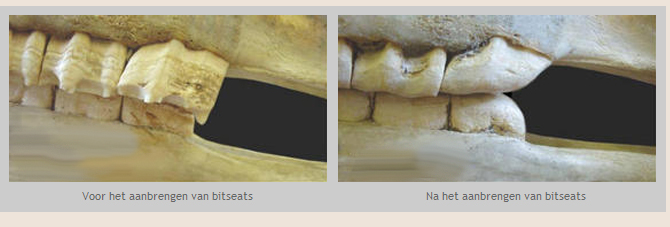
Some ideas get repeated so often in the horse world that, after a while, they sound like common sense. For me, bit seats are a good example.
The idea sounds appealing. Round off the front of the first cheek teeth, give the bit a little more room, and the horse should feel more comfortable and accept the contact more readily. But the longer I look at that argument, the more questions I have.
What are we actually doing when we create a bit seat? We are removing tooth tissue to round or shorten the front edge of the first cheek teeth. Before I pick up a rasp, I want to know what problem that horse needs me to solve.
Where does the bit sit?
The reasoning starts with the assumption that changing the shape of those teeth makes the bit sit more comfortably. Yet a correctly fitted bit sits in the gap in front of the cheek teeth. If a horse seems uncomfortable in the contact, what makes us think the first thing to change is the shape of a healthy tooth?
That is my first concern. We may be altering healthy tissue to address a problem whose cause lies somewhere else.
What does the rider feel, and what do we know?
Ask why people use bit seats and the answers are often practical. A rider might say their horse feels softer, takes a steadier contact or offers less resistance.
I take those observations seriously. But what a rider feels afterwards is one thing. Knowing which part of a treatment made the difference is another. I have yet to see convincing scientific evidence for creating bit seats as a matter of routine. When the benefit is uncertain and the tooth is alive, that matters to me.
What lies beneath the surface
It is easy to picture a tooth as a hard edge you can shape like a piece of wood. Inside the tooth, dentine protects the pulp, which contains nerves and blood vessels. Taking too much off, or working too aggressively, can do considerably more than round an edge.
If too much protective tissue is removed, sensitive structures can become exposed. The result can be pain, sensitivity or inflammation. In more serious cases the pulp can be damaged or die, leaving the tooth vulnerable to infection and, eventually, an abscess. That is quite a price for a change that was supposed to make a horse more comfortable.
Heat matters too
If you have ever sat in a dentist’s chair, you will be familiar with the spray of water as the dentist works. One reason for that water is to protect the tooth from heat. The same concern applies when working on a horse’s teeth. Grinding can generate heat, and damage inside a tooth may be invisible from the outside.
It is another reason I am cautious about how much work is done to a tooth, and why it is being done in the first place.
How much is “just a little”?
A bit seat is sometimes described as taking a little off an edge. In practice, the amount of tooth removed can be considerable. At that point we are permanently changing the shape of a tooth in the hope of making a difference under saddle. The hoped-for benefit is uncertain. The tooth tissue we remove is gone.
When an edge does need attention
There are good reasons to treat the front of a cheek tooth. A prominent hook, an abnormal wear pattern that interferes with chewing, or a sharp enamel point that is causing discomfort may all warrant attention. In those cases I can show the owner what I have found and explain what I hope to achieve for their horse.
That distinction matters. Smoothing a small, sharp enamel point and removing a substantial amount of healthy tooth to create a “seat” for the bit are two very different decisions.
When a horse is uneasy in the contact
A horse that resists the bit or struggles to maintain a comfortable contact can have any number of reasons. Does the bit fit? How does the bridle sit? Is there tension in the jaw, the neck or elsewhere in the body? What is happening in the training, or at the other end of the reins? Pain elsewhere can play a part. So can a dental problem that has nothing to do with bit seats.
If we start with the idea that the first cheek tooth needs rounding, it becomes very easy to overlook the answer the horse is giving us elsewhere.
First, do no harm
I keep coming back to the same principle in my work. Treat what needs treating, and do as little harm as possible in the process. A long-standing habit still deserves a good reason, especially when the possible harm is real and the benefit uncertain.
That is why I oppose routine bit seats and believe excessive reduction can be harmful. A healthy, functioning set of teeth deserves care, knowledge and restraint.
When I stand next to a horse with a rasp in my hand, the question is quite simple. What does this particular horse gain if I take this tissue away? If I cannot give the owner a good answer, I would rather put the rasp down. The horse’s welfare is what should guide that decision.